
How Do Scientists Rate Tornadoes?
EF1, EF3, EF5. You hear the numbers on the news. Who decides, and how?
 Video landing soon!The bots are polishing this one. Scroll down for the full story.
The quick answer
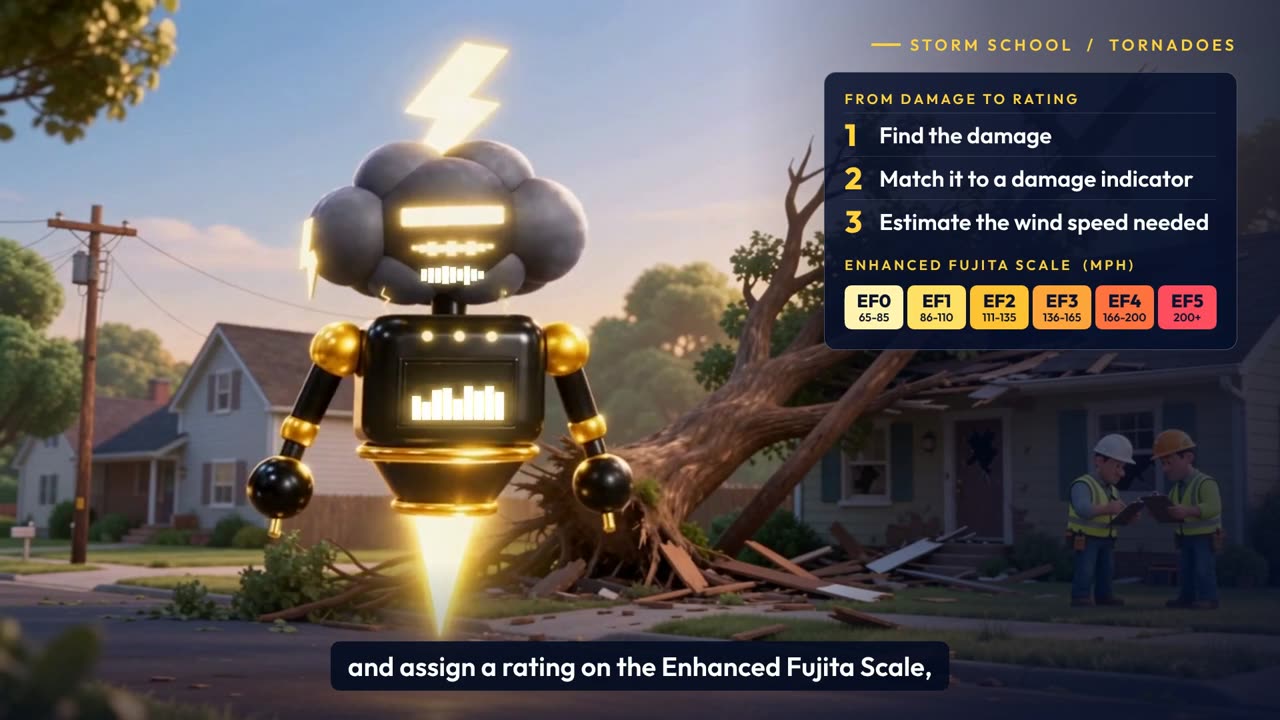
Nobody can hold a wind gauge inside a tornado. So after the storm, National Weather Service teams become detectives. They study the damage, work out how strong the wind must have been, and give the tornado a rating on the Enhanced Fujita Scale, from EF0 to EF5.
How it works
Find the damage
Survey teams walk or drive the tornado's whole path. They look at homes, buildings, trees, power poles and other structures.
Match it to a damage indicator
The scale lists 28 kinds of things a tornado might hit, from barns to schools to hardwood trees. For each one it describes different levels of damage.
Estimate the wind
Each level of damage matches a range of wind speeds. A few shingles missing means much weaker wind than a well-built house swept off its foundation.
Assign the rating
The tornado is rated by the worst damage it caused anywhere along its path.
The scale
| Rating | Estimated wind | Typical damage |
|---|---|---|
| EF0 | 65 to 85 mph | Shingles peeled, branches broken |
| EF1 | 86 to 110 mph | Roofs badly damaged, mobile homes overturned |
| EF2 | 111 to 135 mph | Roofs torn off houses, big trees snapped |
| EF3 | 136 to 165 mph | Whole floors of houses destroyed |
| EF4 | 166 to 200 mph | Well-built houses leveled |
| EF5 | Over 200 mph | Strong houses swept clean away |
Thunder Tidbits
- The scale is named for Dr. Ted Fujita, a scientist so devoted to studying tornadoes that people called him 'Mr. Tornado'.
- An EF rating is the wind estimated from damage. It is not always the strongest wind inside the tornado.
- In 2013 a tornado near El Reno, Oklahoma, grew to 2.6 miles wide, the widest ever recorded. Mobile radar measured winds near 300 miles per hour, but its official rating is EF3, because the strongest winds crossed open country with nothing there to show EF4 or EF5 damage.
Words to know
- Enhanced Fujita Scale
- The 0 to 5 scale used to rate tornadoes in the United States since 2007. The EF stands for Enhanced Fujita.
- Damage indicator
- A type of building or object that surveyors examine.
- Survey
- A careful inspection of the tornado's path after the storm.
- Estimate
- A careful, evidence-based best guess.
Try it: Be a damage detective
After the next windy day, take a walk with a notebook. What did the wind do? Leaves moved, small twigs down, a trash can tipped over? Rank what you find from weakest wind to strongest. You are doing a tiny version of what survey teams do.
Stay safe
Every tornado is dangerous, whatever number it ends up with. The rating comes after the storm. The warning comes before it, and the warning is the part to act on.
Quiz yourself
Say your answer out loud, then tap to check.
What do survey teams study to rate a tornado?
The damage it left behind.
What is the highest rating on the scale?
EF5, with winds over 200 miles per hour.
Why was the huge El Reno tornado rated only EF3?
Its strongest winds passed over open land, so there was no damage there to prove a higher rating.
For grown-ups: where the facts come from
Keep exploring
 Video landing soon
Why Do Tornadoes Spin?
Wind usually just blows past you. So how does it end up whirling in a giant circle?
Video landing soon
Why Do Tornadoes Spin?
Wind usually just blows past you. So how does it end up whirling in a giant circle?
 Video landing soon
What Causes Lightning?
A lightning bolt crosses the sky in a blink. Where does all that electricity come from?
Video landing soon
What Causes Lightning?
A lightning bolt crosses the sky in a blink. Where does all that electricity come from?
 Video landing soon
What Causes a Blizzard?
Two feet of snow fell overnight. Was that a blizzard? Not always!
Video landing soon
What Causes a Blizzard?
Two feet of snow fell overnight. Was that a blizzard? Not always!