
How Do Deserts Form?
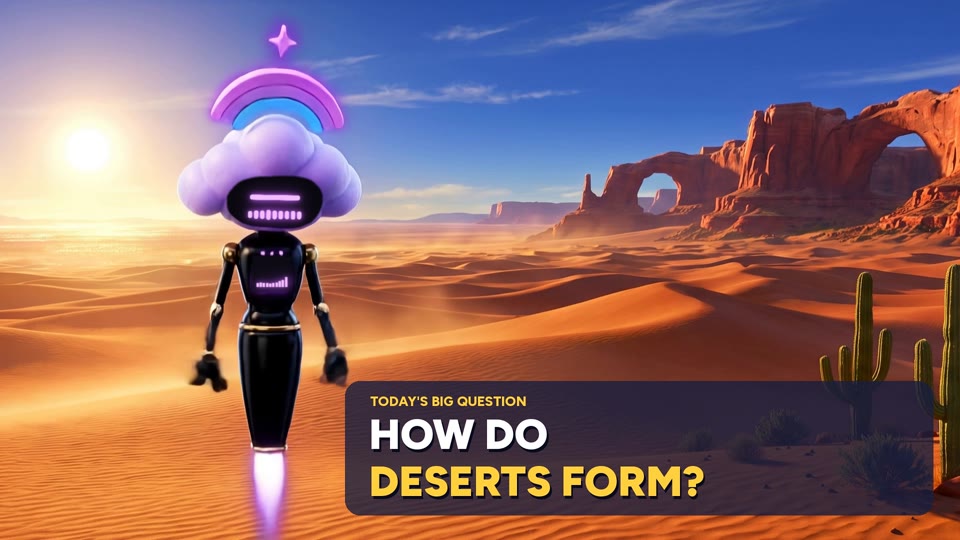
Some places are covered in forests. Others can go months or even years with almost no rain. Why?
 Video landing soon!The bots are polishing this one. Scroll down for the full story.
The quick answer
A desert is not a place that is hot. It is a place that is dry. Deserts form wherever something keeps the rain away: sinking air, a wall of mountains, a cold ocean current, or simply being a very long way from the sea.
How it works
Dry is the rule, not hot
Scientists usually call a place a desert if it gets less than about 10 inches (250 millimeters) of rain or snow in a whole year. Some deserts are scorching. Others are freezing.
Sinking air keeps the clouds away
Near the equator, warm air rises and drops its moisture as heavy rain. That air then spreads out high above the ground and sinks back down around 30 degrees north and south. Sinking air warms up and dries out, so clouds struggle to form. Many of the world's biggest deserts, like the Sahara, sit under that sinking air.
Mountains wring out the rain
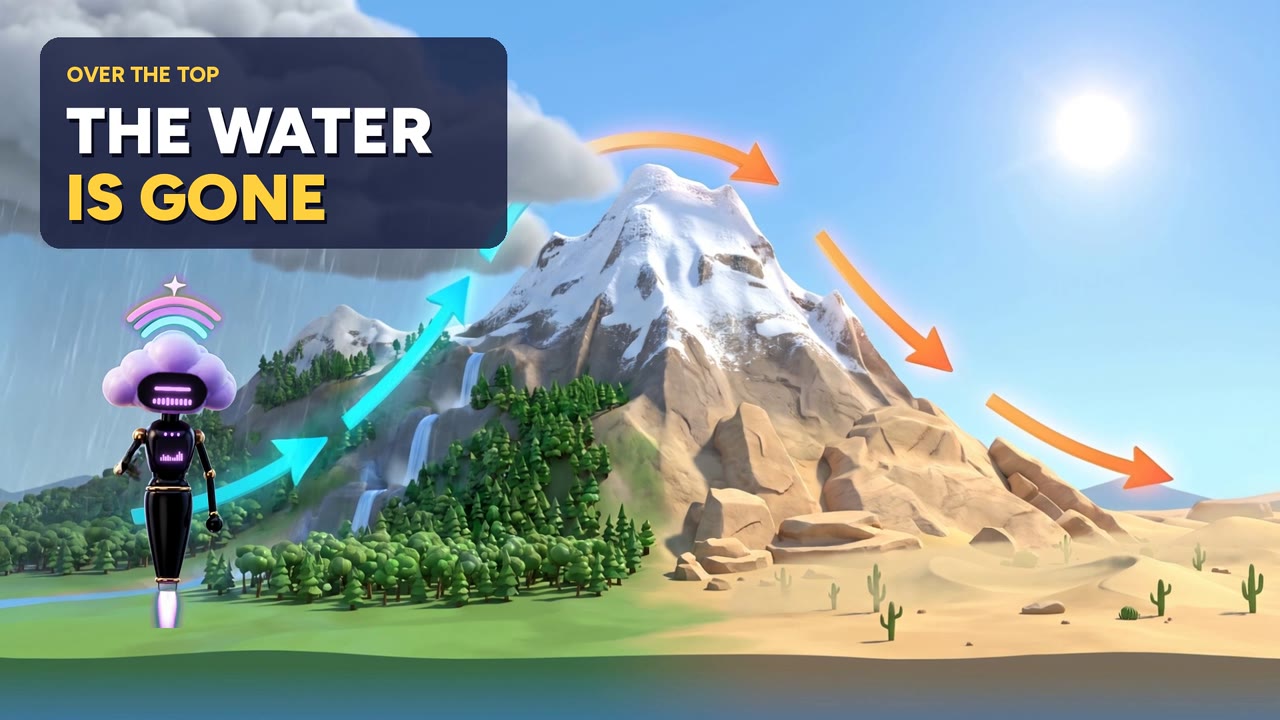
When moist air runs into a mountain range it is forced upward. It cools, and its water falls as rain or snow on that side. By the time the air comes down the far side, most of its moisture is gone. The dry land behind the mountains is called a rain shadow.
Cold currents and long distances
Cold ocean water chills the air above it, and cool air does not rise easily to build rain clouds. That helps make coastal deserts like the Atacama in Chile. Other deserts, like the Gobi, are so far inland that the air has lost its moisture long before it arrives.
Thunder Tidbits
- Antarctica is the largest desert on Earth. It is covered in ice, but very little new snow falls there each year.
- The Sahara is the largest hot desert. It is roughly the size of the United States.
- Parts of the Atacama Desert in Chile have gone years without measurable rain.
- Deserts can be freezing at night. With dry air and few clouds, the day's heat escapes quickly after sunset.
Words to know
- Desert
- A place that gets very little rain or snow.
- Precipitation
- Water that falls from the sky: rain, snow, sleet or hail.
- Rain shadow
- The dry area on the sheltered side of a mountain range.
- Arid
- Very dry.
- Evaporation
- Liquid water turning into water vapor and rising into the air.
Try it: Measure your own rain
Set a straight-sided jar or cup outside in an open spot and tape a ruler to the side. Check it after each rainy day for a month and add up the total. A desert gets less than about 10 inches in a whole year. How does your month compare?
Stay safe
Deserts can be dangerous for people who are not ready for them. Carry plenty of water, wear a hat and sunscreen, stay with a grown-up, and remember that the temperature can drop fast once the Sun goes down.
Quiz yourself
Say your answer out loud, then tap to check.
True or false: a desert has to be hot.
False. A desert is defined by being very dry, not by its temperature.
What is a rain shadow?
The dry side of a mountain range, where the air has already dropped its rain or snow on the other side.
What is the largest desert on Earth?
Antarctica.
For grown-ups: where the facts come from
Keep exploring
 Video landing soon
What Is the Coldest Place on Earth?
Your freezer at home is pretty cold. How much colder can planet Earth actually get?
 Video landing soon
Why Are Sunsets Red and Orange?
The sky is blue all day. Then the Sun starts to set and everything turns orange, pink and red. What changed?
 Video landing soon
Hurricane, Typhoon or Cyclone: What Is the Difference?
Hurricane. Typhoon. Cyclone. Are those three different kinds of storms?