
What Is the Coldest Place on Earth?
Your freezer at home is pretty cold. How much colder can planet Earth actually get?
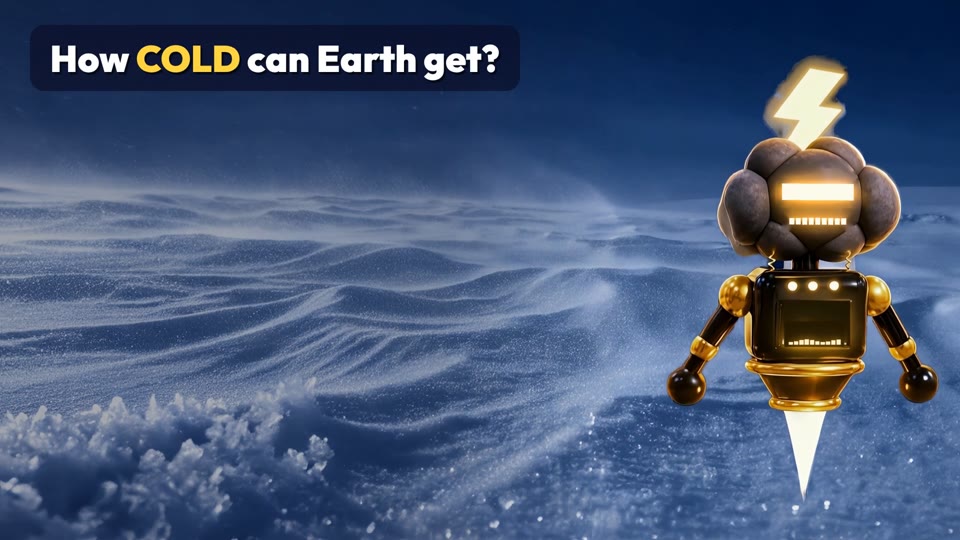 Video landing soon!The bots are polishing this one. Scroll down for the full story.
The quick answer
The coldest air ever officially measured on Earth was minus 89.2 degrees Celsius. That is minus 128.6 degrees Fahrenheit. It was recorded at Vostok Station in Antarctica on July 21, 1983. Antarctica gets that cold because several things all push the temperature down at once.
How it works
Months of darkness
Near the South Pole the Sun stays below the horizon for months every winter. With no sunlight coming in, the ground and the air just keep losing heat.
High above the sea
Much of Antarctica is a thick sheet of ice piled miles deep. Vostok Station sits about 11,400 feet (roughly 3,500 meters) above sea level. The higher you go, the colder the air gets.
A giant mirror
Bright white snow and ice bounce most sunlight straight back toward space instead of soaking up its warmth.
Clear, dry air
Clouds and moist air act like a blanket that holds heat in. The air over the middle of Antarctica is extremely dry and often clear, so heat escapes to space quickly.
Thunder Tidbits
- A home freezer is about minus 18 degrees Celsius (0 degrees Fahrenheit). The Vostok record is roughly 70 Celsius degrees colder than that.
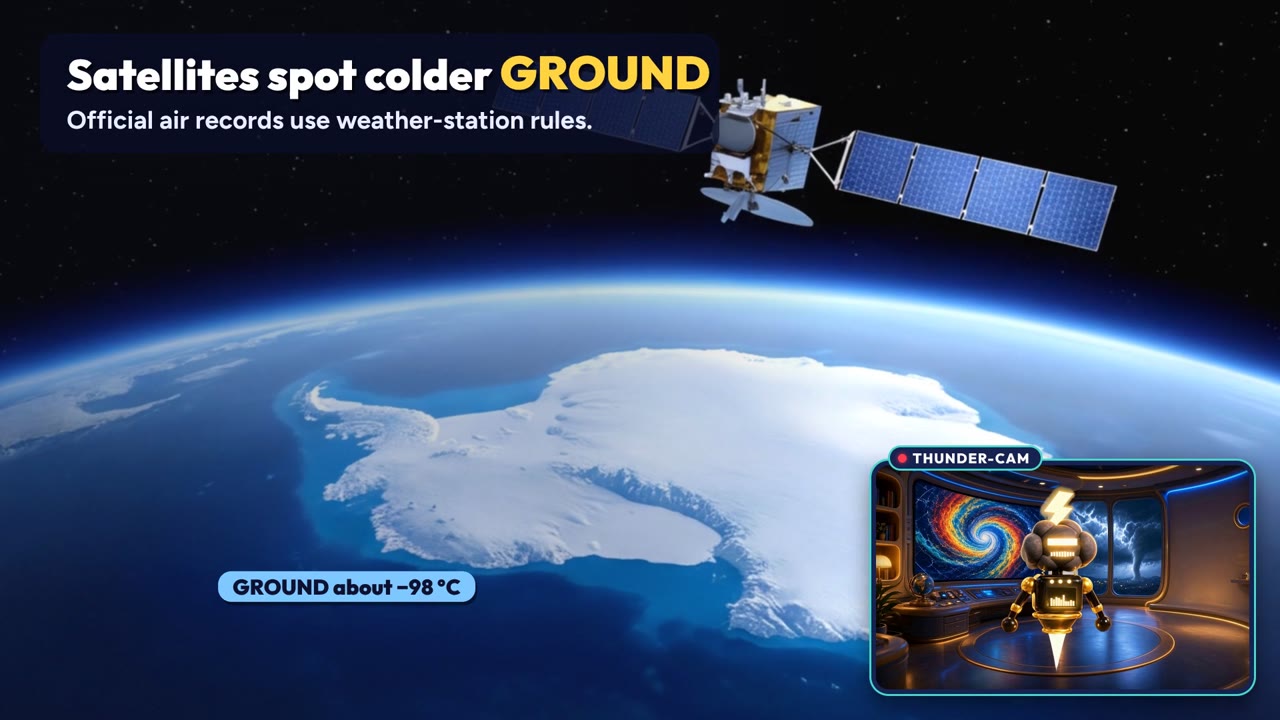
- Satellites have spotted even colder patches of ground on the high ice of East Antarctica: about minus 98 degrees Celsius (minus 144 degrees Fahrenheit).
- Those satellite readings are not the official record. Official air temperature records have to be measured by a weather station following set rules.
- Vostok Station sits on ice more than two miles thick, and a huge lake of liquid water lies hidden far beneath it.
Words to know
- Antarctica
- The icy continent around the South Pole.
- Elevation
- How high a place is above sea level.
- Reflect
- To bounce light back instead of soaking it up.
- Weather station
- A set of instruments that measures the weather in one spot, the same way every time.
- Ice sheet
- A huge, thick layer of ice covering the land.
Try it: Test the giant mirror
On a sunny day, lay a sheet of black paper and a sheet of white paper side by side in the sunshine. Wait ten minutes, then touch each one. Which is warmer? The white sheet bounces more sunlight away, just like Antarctica's snow and ice.
Stay safe
You do not need Antarctica for cold to be dangerous. On very cold days, dress in layers, cover your hands, ears and face, stay dry, and come inside to warm up if anything starts to feel numb.
Quiz yourself
Say your answer out loud, then tap to check.
What is the coldest air temperature ever officially recorded?
Minus 89.2 degrees Celsius, or minus 128.6 degrees Fahrenheit.
Where and when was it recorded?
Vostok Station, Antarctica, in July 1983.
Name two reasons Antarctica gets so cold.
Any two of these: months of winter darkness, high elevation, snow and ice reflecting sunlight, and clear, dry air that lets heat escape.
For grown-ups: where the facts come from
Keep exploring
 Video landing soon
Why Are Sunsets Red and Orange?
The sky is blue all day. Then the Sun starts to set and everything turns orange, pink and red. What changed?
 Video landing soon
Hurricane, Typhoon or Cyclone: What Is the Difference?
Hurricane. Typhoon. Cyclone. Are those three different kinds of storms?
 Video landing soon
How Do Waterspouts Form?
Wait. Is that a tornado out on the ocean?