
What Is the Jet Stream?
There is a river of fast-moving air high above your head that can steer storms across entire continents.
 Video landing soon!The bots are polishing this one. Scroll down for the full story.
The quick answer
The jet stream is a narrow band of powerful wind several miles above Earth, near the top of the troposphere. It usually blows from west to east, and its waves help decide where cold air, warm air and storms end up.
How it works
A band of fast wind
The jet stream is a ribbon of very fast air several miles up. Its winds can reach more than 150 miles per hour.
Cold air meets warm air
One big reason it exists is the temperature difference between cold polar air and warmer air farther south.
Pressure gets air moving
Big temperature contrasts create differences in air pressure high in the atmosphere, and that sets the air in motion.
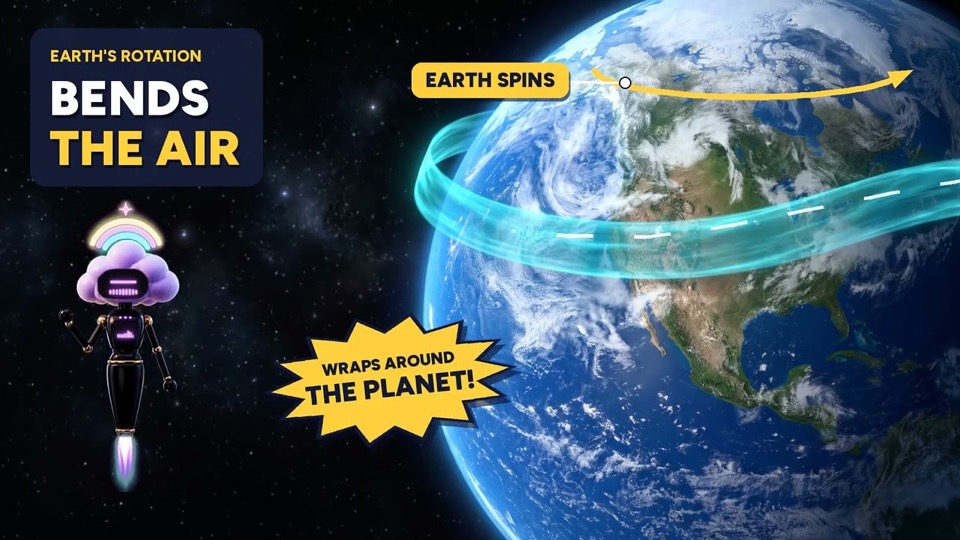
Earth's spin bends it
Because Earth rotates, the moving air gets turned. The result is a fast current flowing from west to east that wraps around the planet.
It wiggles
The jet stream is not a straight line. It develops huge waves. A dip to the south can pull cold air down with it, and a bulge to the north lets warm air move farther north.
It steers storms
Low-pressure systems, thunderstorms and winter storms tend to travel along the jet stream, like leaves carried on a river.
Thunder Tidbits
- The strongest jet stream winds can blow faster than 250 miles per hour.
- Airplanes flying east often ride the jet stream to save time and fuel. Flying west against it takes longer.
- Earth has more than one jet stream. Each half of the planet has a polar jet and a subtropical jet.
Words to know
- Jet stream
- A narrow band of very fast wind high in the atmosphere.
- Troposphere
- The lowest layer of the atmosphere, where almost all weather happens.
- Air pressure
- The push of the air pressing on everything around it.
- Latitude
- How far north or south of the equator a place is.
- Low-pressure system
- An area of rising air that often brings clouds and storms.
Try it: Draw the jet stream
Look at a weather map with a grown-up, or search for today's jet stream map. Find where the band dips south and where it bulges north. Is it colder under the dip? Check again in a few days and see how the waves have moved.
Stay safe
When forecasters say the jet stream is dipping your way, colder or stormier weather may follow. It is a good reminder to check the forecast and dress for it.
Quiz yourself
Say your answer out loud, then tap to check.
Which way does the jet stream usually blow?
From west to east.
What helps create the jet stream?
The temperature difference between cold polar air and warmer air, plus Earth's rotation.
What can a southward dip in the jet stream bring?
Colder air.
For grown-ups: where the facts come from
Keep exploring
 Video landing soon
Why Do Tornadoes Spin?
Wind usually just blows past you. So how does it end up whirling in a giant circle?
 Video landing soon
What Causes Lightning?
A lightning bolt crosses the sky in a blink. Where does all that electricity come from?
 Video landing soon
What Causes a Blizzard?
Two feet of snow fell overnight. Was that a blizzard? Not always!