
What Causes Lightning?
A lightning bolt crosses the sky in a blink. Where does all that electricity come from?
 Video landing soon!The bots are polishing this one. Scroll down for the full story.
The quick answer
Lightning is a giant spark. Inside a storm cloud, bits of ice crash into each other and build up electric charge, a lot like your socks on carpet. When the charge gets too big for the air to hold back, it jumps.
How it works
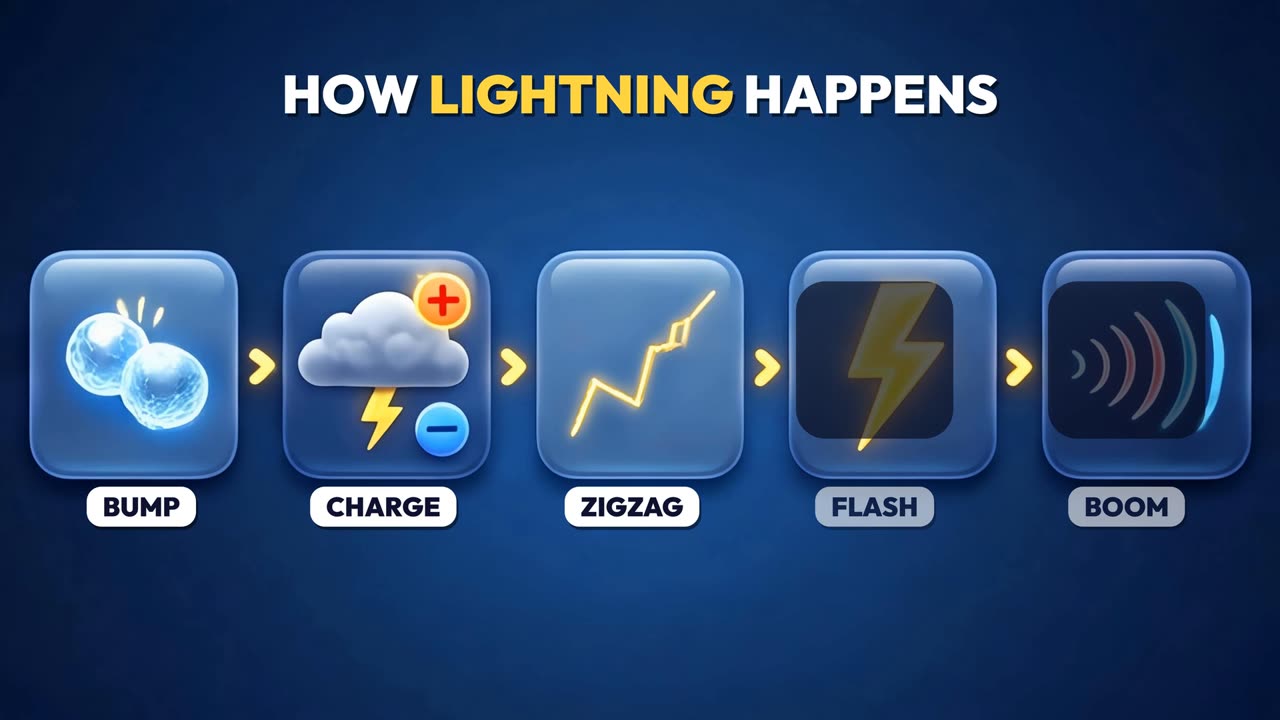
Bump
A thunderstorm is full of tiny ice crystals, water droplets and soft little hail pellets called graupel. Strong winds inside the cloud fling them up and down, and they smack into each other millions of times.
Charge
Each collision moves a little electric charge. Lighter ice crystals carry positive charge toward the top of the cloud. Heavier graupel carries negative charge toward the bottom. The cloud turns into a giant battery.
Zigzag
When the charge is strong enough, a faint path of electricity starts stepping down toward the ground in jagged jumps. It is too dim and too quick for you to notice.
Flash
As that path gets close, a spark reaches up from the ground to meet it. The moment they connect, a huge surge of electricity races along the channel. That bright surge is the flash you see.
Boom
The bolt heats the air around it so fast that the air explodes outward. That shock wave is thunder.
Thunder Tidbits
- The air around a lightning bolt can reach about 50,000 degrees Fahrenheit. That is roughly five times hotter than the surface of the Sun.
- Most lightning never touches the ground. It stays inside the cloud or jumps from cloud to cloud.
- Satellites count around 40 to 50 lightning flashes on Earth every single second.
Words to know
- Charge
- The electric 'push' that builds up when tiny particles gain or lose electrons.
- Graupel
- Soft, small ice pellets inside a storm cloud. Say it: GROW-pull.
- Discharge
- Built-up electricity suddenly letting go.
- Channel
- The thin path the lightning travels along.
Try it: How far away was that?
Light reaches you almost instantly, but sound is slower. When you see a flash, count the seconds until you hear the thunder, then divide by five. That is about how many miles away the lightning was. Fifteen seconds means roughly three miles.
Stay safe
When thunder roars, go indoors. If you can hear thunder, lightning is close enough to reach you. Wait 30 minutes after the last rumble before heading back out.
Quiz yourself
Say your answer out loud, then tap to check.
What is bumping together inside the cloud to build up charge?
Ice crystals, water droplets and soft hail called graupel.
Which is hotter: lightning or the surface of the Sun?
Lightning, by about five times, for a tiny fraction of a second.
You count 10 seconds between flash and boom. How far away is the lightning?
About two miles.
For grown-ups: where the facts come from
Keep exploring
 Video landing soon
What Causes a Blizzard?
Two feet of snow fell overnight. Was that a blizzard? Not always!
Video landing soon
What Causes a Blizzard?
Two feet of snow fell overnight. Was that a blizzard? Not always!
 Video landing soon
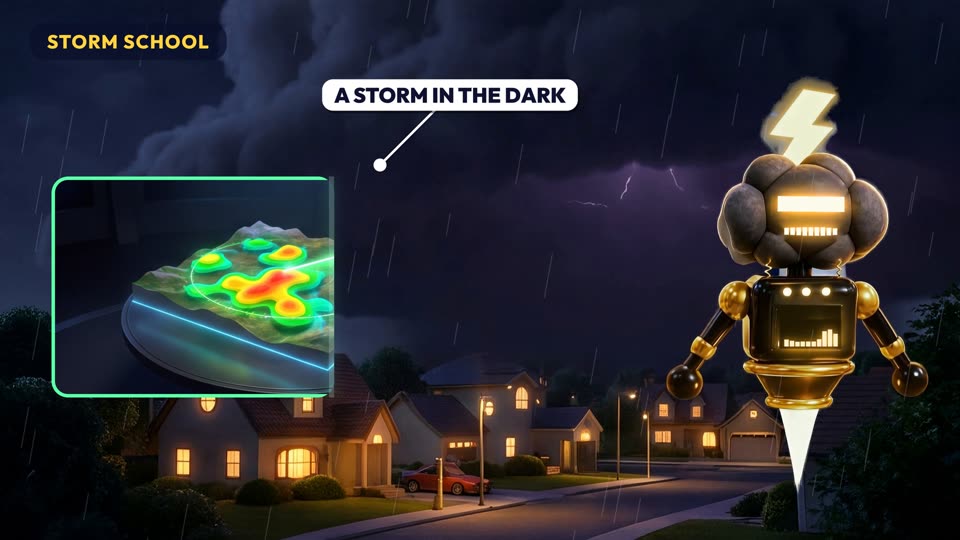
How Does Weather Radar See a Storm?
It is the middle of the night and pouring rain. Somehow a machine still knows exactly where the storm is. How?
Video landing soon
How Does Weather Radar See a Storm?
It is the middle of the night and pouring rain. Somehow a machine still knows exactly where the storm is. How?
 Video landing soon
What Do Hurricane Hunters Actually Do?
Would you fly an airplane straight into a hurricane? On purpose?
Video landing soon
What Do Hurricane Hunters Actually Do?
Would you fly an airplane straight into a hurricane? On purpose?