
How Does Weather Radar See a Storm?
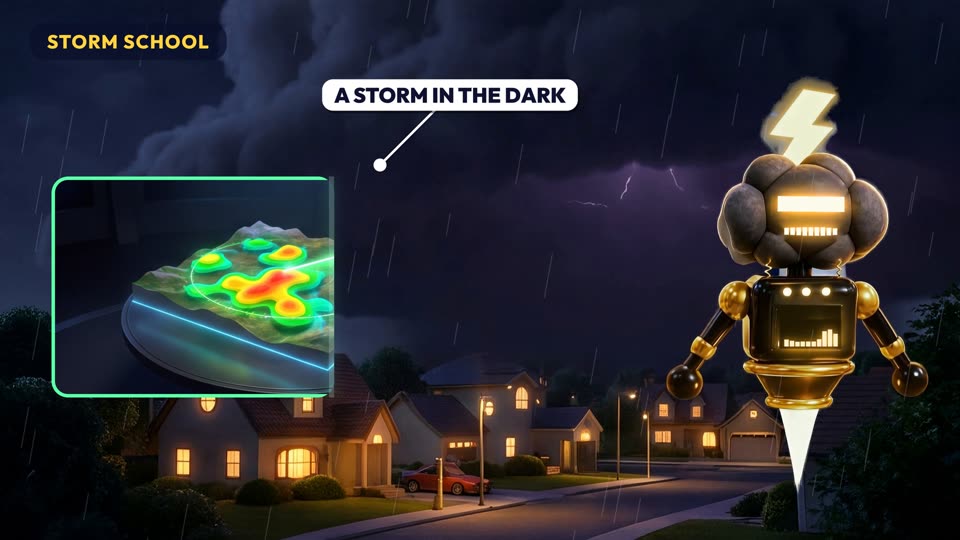
It is the middle of the night and pouring rain. Somehow a machine still knows exactly where the storm is. How?
 Video landing soon!The bots are polishing this one. Scroll down for the full story.
The quick answer
Radar does not take a photo. It shouts and listens. It sends out pulses of invisible radio energy, waits for the echoes that bounce off rain, hail and snow, and builds a picture from what comes back.
How it works
Send a pulse
A big spinning dish inside a dome that looks like a giant golf ball sends out a very short burst of radio energy.
Listen for the echo
When the pulse hits raindrops, hailstones or snowflakes, a tiny bit bounces straight back. The radar spends almost all of its time listening, not sending.
Time the trip
The longer the echo takes to return, the farther away the rain is. It is like throwing a ball at a wall: a far wall means a longer wait.
Measure the strength
A weak echo means light rain. A strong echo means heavy rain or hail. On the map, weak echoes are drawn in green and strong ones in yellow, orange and red.
Catch the motion
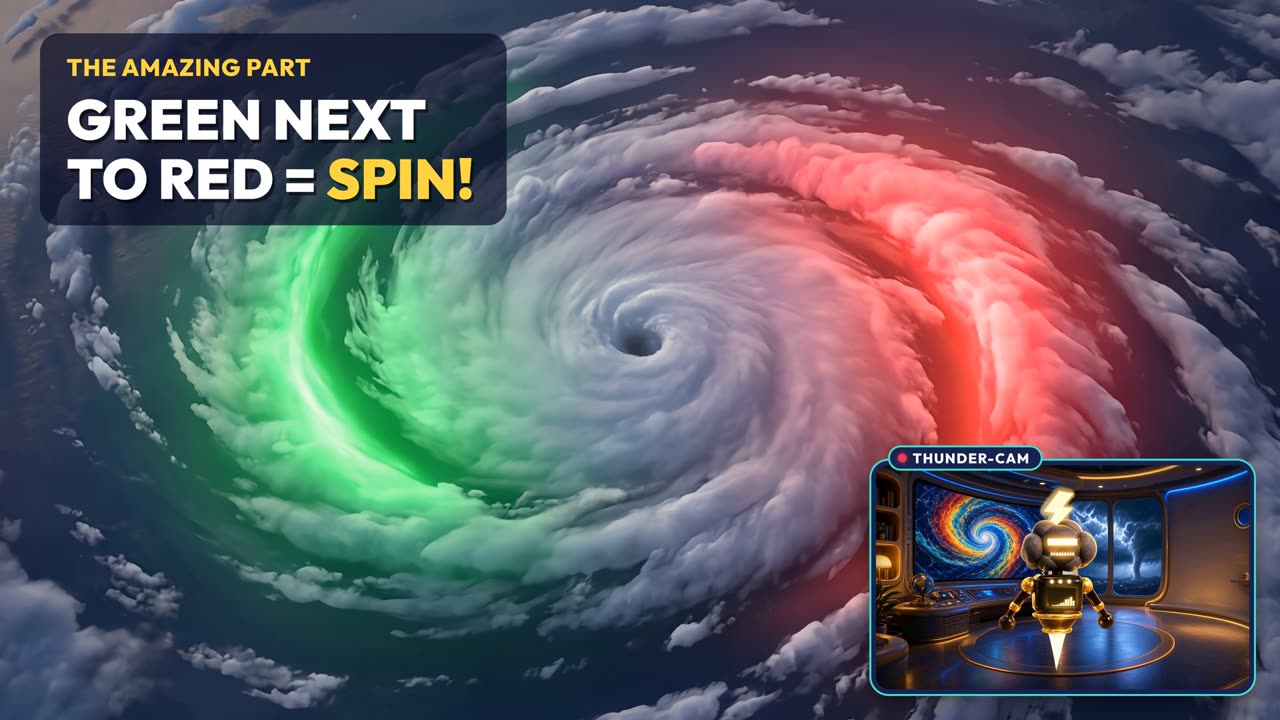
Doppler radar can also tell if the raindrops are moving toward it or away from it. When 'toward' and 'away' show up side by side, the storm is rotating, and forecasters know to watch for a tornado.
Thunder Tidbits
- The United States is covered by a network of about 160 Doppler radars called NEXRAD.
- Radar can spot a spinning storm in total darkness or when the tornado is wrapped in rain.
- Radar picks up more than weather. Meteorologists sometimes see flocks of birds, swarms of insects and even bats leaving their caves at sunset.
Words to know
- Radar
- Short for RAdio Detection And Ranging.
- Pulse
- A very short burst of radio energy.
- Echo
- The part of the pulse that bounces back.
- Doppler effect
- A change in a wave caused by motion. It is why a siren sounds higher coming toward you and lower going away.
- Reflectivity
- How much energy came back. It is what the colors on a radar map show.
Try it: Be a human radar
Stand about 30 big steps from a large flat wall, like the side of a school gym. Clap once, loudly, and listen for the echo. Now move closer and try again. The echo comes back sooner. That time gap is exactly what radar uses to measure distance.
Stay safe
A radar map is a great tool, but it is not a warning. If a watch or warning is issued for where you are, follow it even if the sky still looks fine.
Quiz yourself
Say your answer out loud, then tap to check.
What does radar send out?
Pulses of radio energy.
What does red usually mean on a radar map?
A strong echo: heavy rain or hail.
What can Doppler radar measure that ordinary radar cannot?
Whether the rain is moving toward or away from the radar, which reveals wind and rotation.
For grown-ups: where the facts come from
Keep exploring
 Video landing soon
What Do Hurricane Hunters Actually Do?
Would you fly an airplane straight into a hurricane? On purpose?
Video landing soon
What Do Hurricane Hunters Actually Do?
Would you fly an airplane straight into a hurricane? On purpose?
 Video landing soon
The 2004 Indian Ocean Tsunami
On December 26, 2004, the ocean began to move on a scale almost impossible to imagine.
Video landing soon
The 2004 Indian Ocean Tsunami
On December 26, 2004, the ocean began to move on a scale almost impossible to imagine.
 Video landing soon
Five of the Strangest Weather Events
Ready for weather that sounds made up, but really happens?
Video landing soon
Five of the Strangest Weather Events
Ready for weather that sounds made up, but really happens?